/ PROJECT NOTE
When health is already good, what should we optimize next?
When diet, sleep, and exercise are already in good shape, how much additional benefit can the next dollar spent on health actually buy?
Recently, I began reviewing my supplement routine for Project 160.
I have long been interested in health and longevity. Over the years, alongside diet and exercise, I have tried supplements, grounding mats, red-light devices, vitamin A skincare, dry brushing, and even the rather folkloric practice of putting castor oil in my navel.
I know the scientific evidence behind these approaches varies considerably. Still, I have remained fairly open to exploring new methods. Project 160 is, after all, a long-term N=1 experiment.
So I began another round of supplement research with AI.
Vitamins, fish oil, creatine, coenzyme Q10, magnesium: we looked at doses, ingredients, absorption, and human studies. I also put Bryan Johnson’s supplement routine into a table for an item-by-item comparison.
The discussion was useful, and I did settle on a revised supplement list.
But something more valuable than the list emerged along the way: another question.
What are we actually optimizing?
When discussing vitamins C and D, AI repeatedly cited recommended intakes set by Japan’s Ministry of Health, Labour and Welfare and other institutions.
These standards clearly matter, and their purpose extends well beyond preventing severe deficiencies such as scurvy.
Their main focus, however, is nutritional needs and health risks in the general population. My question was different:
If the goal is not merely to avoid deficiency but to maximize healthspan, how much do we really know about what is optimal?
Recommended intake is not necessarily the optimal amount for longevity. Equally, there is no evidence that more is always better.
This is not a rejection of nutrition science. It is an acknowledgment of its scope and of how much remains unknown about aging.
More importantly, I began to wonder whether I was devoting too much attention to a relatively minor area of improvement.
There is extensive evidence for the long-term health effects of diet, sleep, exercise, medical care, and risk management.
By comparison, the additional health benefits of most supplements remain considerably uncertain.
Suppose 95% of someone’s health benefit comes from these fundamentals. That 95% is only a hypothetical illustration of priorities, not a scientific statistic.
Before researching the next supplement, should I first check how much room remains to improve those fundamentals?
Yet that did not make the question simple.
Important fundamentals do not automatically justify premium upgrades
Suppose diet is extremely important.
Is replacing ordinary beef with much more expensive organic, grass-fed beef worthwhile?
Suppose sleep is extremely important.
Is a premium mattress with intelligent temperature control worthwhile?
Suppose exercise is extremely important.
Is spending a lot on a personal trainer worthwhile?
These three questions may seem unrelated to supplements, but their underlying issue is the same.
Grass-fed beef can have a different fatty-acid profile. Temperature regulation may improve some people’s sleep. Supervised training may be more effective than training entirely alone.
These are not invented concepts.
Take omega-3s: grass-fed beef can contain more than grain-fed beef. But comparing the relevant omega-3 fatty acids per 100 g on one chart shows that the difference between the two kinds of beef is still small relative to oily fish.
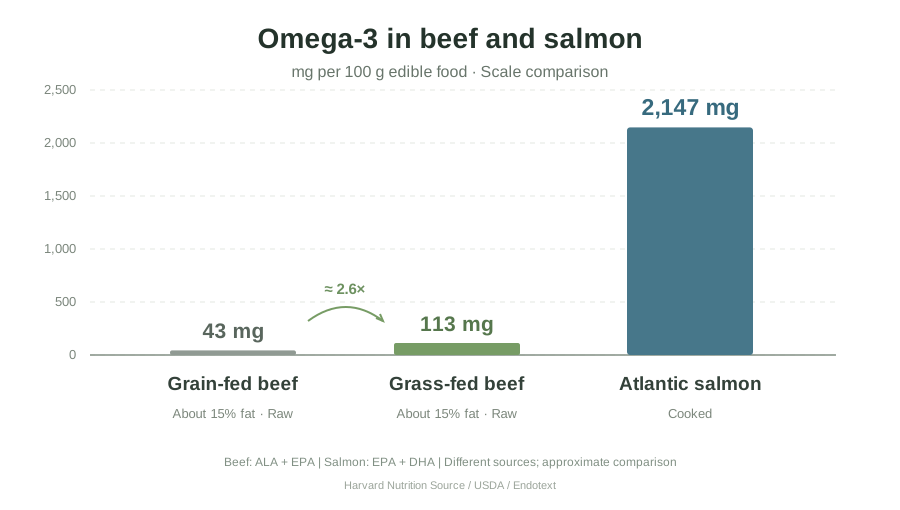
The beef figures use USDA data cited by Harvard Nutrition Source and compare ALA + EPA; the salmon figure uses USDA/Endotext data for EPA + DHA in cooked salmon. All are expressed per 100 g of edible food, but preparation and fatty-acid categories differ. This illustrates orders of magnitude, not a controlled nutritional comparison. Cuts, fat content, and farming conditions also affect the figures. Sources: Harvard Nutrition Source, Endotext / NCBI.
An intervention can have scientific support without being equally valuable for everyone.
For someone who never exercises, a qualified trainer may help establish a lasting exercise habit.
For someone who has trained regularly for years and can plan independently, the extra benefit of an expensive ongoing trainer may be much smaller.
For someone who often wakes because of the heat, a temperature-controlled mattress may solve a real problem.
For someone who already sleeps well, its ability to further improve long-term health is less clear.
The same applies to supplements.
Correcting a deficiency and increasing intake when nutrition is already adequate are two different interventions.
It is easy to assume that the established benefits of the former also apply to the latter.
This brings us to a basic economic concept: Marginal benefit.
Moving from poor health to good health can be a major improvement.
But as we move from good health toward ever more elaborate and expensive health management, how much does each additional investment deliver?
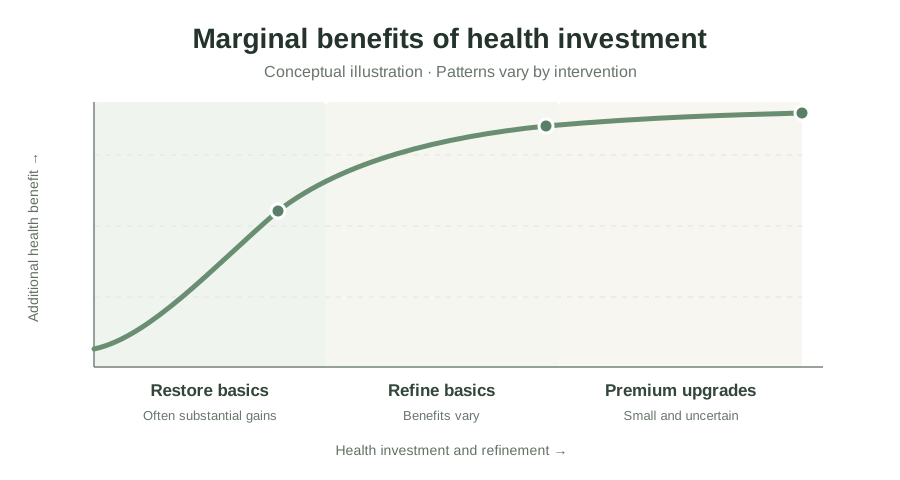
A conceptual illustration, not a measured human health-benefit curve; different interventions may follow different patterns.
That is the question I really wanted to ask.
Calling it a rip-off may be too simple
Online judgments of health products often fall into two extremes.
One side calls them essential, must-buy, or anti-aging miracles.
The other calls them useless or a tax on the gullible.
Reality is often more complicated.
Consider coenzyme Q10.
Its important role in mitochondrial energy metabolism is an established biological fact.
Yet the body’s need for CoQ10 does not establish that supplementation improves mitochondrial function in healthy people, let alone extends life.
At the same time, a lack of sufficient long-term clinical evidence does not establish that it has no value.
We need to distinguish three levels:
Does it have a physiological role? Does supplementation produce practical health benefits? Do those benefits apply to me?
These questions do not automatically have the same answer.
A rip-off may involve more than simply buying something with no effect.
Sometimes a product works, but only a little or only for particular groups. Sellers then turn limited evidence into claims of large, universal health benefits.
The premium price is out of proportion to the extra value received.
Conversely, a product without proven life-extension benefits may still be worth buying.
If it substantially improves comfort, makes me more willing to exercise, or solves a persistent sleep problem, it may be a reasonable purchase even if the benefit cannot be converted into years of life gained.
Rather than labeling each product useful or a rip-off, I want to know:
What problem does it solve? How large is the effect? Who benefits? What does it cost?
Longevity is not an endless upgrade cycle
Putting these questions together, I began to see another possibility.
Once reasonably good habits are in place, the most important next step may not be to keep buying more advanced equipment in every area.
It may be to identify what is actually limiting my health.
If my diet is already good enough, pursuing more expensive ingredients may not be the best use of resources.
If sleep is clearly a problem, improving the sleep environment may matter more than adding another supplement.
If the fundamentals are already sound, regular checkups, observing long-term changes, or simply adding nothing may also be reasonable choices.
That does not mean every health investment must pay off immediately.
Given the goal of Project 160, I still want to follow emerging approaches with a plausible scientific basis, even when they have not yet been fully validated.
But I want to make clearer distinctions:
Interventions shown to work, hypotheses that need testing, and experiments I personally want to try.
All three can coexist, provided they are kept distinct.
Will I still take supplements?
Yes.
This discussion did not make me return all the supplements I had already bought.
Nor do I think a healthy life can only consist of eating, sleeping, and exercising.
Our understanding of aging is still limited. I want Project 160 to follow new scientific developments as well as established health guidance.
But I now have another criterion for my next health investment.
It goes beyond whether something works or has a scientific paper behind it.
The question is:
Starting from my current health, what additional value can this intervention provide?
If the value is clear, it is worth considering.
If evidence is limited but the potential benefit is interesting and the risks and costs are manageable, it may be worth exploring.
If it only adds complexity without a clear account of what improves, it may be better to leave it for now.
Project 160 is a long-term experiment, not a competition to buy the most health products.
I certainly hope to live long enough to see more genuine breakthroughs in medicine.
Until then, I want each health investment to become a more deliberate choice, rather than automatically adding every interesting new thing to my list.
The goal of health optimization should be to live better, not to turn life itself into an optimization task that can never be finished.
At least, that is my provisional answer after this discussion.
← Back to all entries